

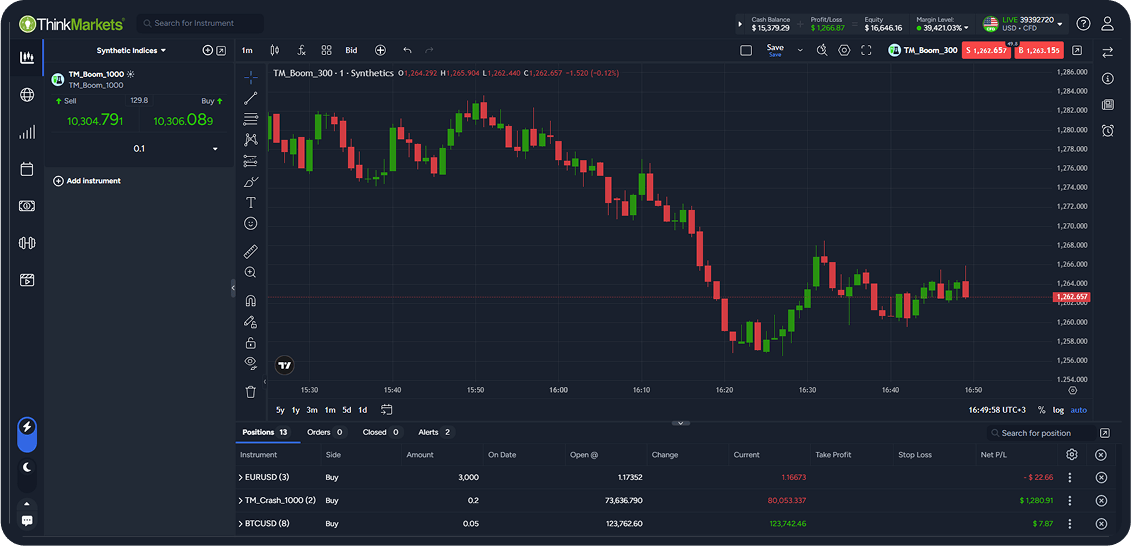
Set a price alert for Boom 1000
Choose a price level in ThinkTrader and we will notify you when the market reaches it. Alerts are informational and do not open or close positions.
Boom 1000 is a synthetic index that moves lower in small steps with occasional sharp upward spikes, generated by an algorithm rather than any real market. It is not linked to shares, currencies or commodities and can be traded as a CFD with ThinkMarkets on ThinkTrader or MT5.
- Boom 1000 is a synthetic index, a simulated market generated by an algorithm rather than a basket of real world assets.
- It is designed to produce an upward price spike on average once in every 1,000 ticks, with smaller downward movements in between.
- Because it is synthetic, it is not driven by company earnings, economic data or central bank decisions, and it trades continuously.
- You can trade Boom 1000 as a CFD, taking a long or short position on its price without owning any underlying asset.
- Its movement is governed by a fixed statistical model, so its spike frequency and volatility profile stay consistent over time.
What is Boom 1000?
Boom 1000 is a synthetic index, a market simulated by an algorithm rather than one based on shares, currencies or commodities. Its price is generated by a random number process with a fixed statistical profile, which is designed so that the market tends to produce a sharp upward spike on average once in every 1,000 ticks, with smaller, more frequent downward movements between spikes. A tick is a single update to the price.
Because the index is generated rather than tied to real world markets, it is not affected by company results, economic releases or geopolitical events, and it is available to trade continuously. When you trade Boom 1000 with ThinkMarkets you are trading it as a CFD, an agreement to exchange the difference in its price between opening and closing your position. You do not own any underlying asset, and because a CFD can be opened long or short, you can take a position in either direction.
What shapes the Boom 1000 price
A fixed statistical model
The defining feature of Boom 1000 is that its behaviour is set by a fixed statistical model rather than by outside events. The model determines how often spikes occur and how large the movements between them tend to be, so the general character of the market stays consistent over time.
The spike mechanic
Boom 1000 is designed to move gradually lower in small steps, then produce an occasional sharp upward spike, on average once in every 1,000 ticks. This gives the index a distinctive shape, with long stretches of smaller moves punctuated by sudden jumps. Understanding this pattern is central to understanding how the index behaves.
Continuous trading
Because it is not tied to any exchange or real world session, Boom 1000 is available to trade continuously, independent of the opening hours of traditional markets. You can follow the timing of upcoming releases in the economic calendar.
Boom 1000 and Crash 1000 at a glance
| Metric / feature | Boom 1000 Synthetic Index | Crash 1000 Synthetic Index |
|---|---|---|
| Type | Synthetic index | Synthetic index |
| Spike behaviour | Periodic upward spikes | Periodic downward spikes |
| Average spike frequency | Around one spike in 1,000 ticks | Around one drop in 1,000 ticks |
| Platform | ThinkTrader and MT5 | ThinkTrader and MT5 |
Trading conditions
The core trading conditions for Boom 1000 are set out below. Maximum leverage on this index is dynamic: the cap steps down as the size of your position grows, as shown in the tier breakdown.
| Instrument | Ticker | Currency | Contract size | Min trade size | Max trade size | Max leverage |
|---|---|---|---|---|---|---|
| Boom 1000 Synthetic Index | TM_BOOM_1000 | USD | 1 | 0.1 lots | 10 lots | 2500:1 |
Max leverage varies based on the total net position value. See the tier breakdown below.
Dynamic leverage and margin tiers
| Position size (lots) | Margin requirement | Maximum leverage |
|---|---|---|
| 5 | 0.04% | 2500:1 |
| 10 | 0.1% | 1000:1 |
| 25 | 0.2% | 500:1 |
| 50 | 0.5% | 200:1 |
| 100 | 1% | 100:1 |
| 1500 | 2% | 50:1 |
How to trade Boom 1000 with ThinkMarkets
Create an account
Sign up via the online form. Choose a live account, or start with a demo to practise first.
Fund your wallet
Add funds using a supported method, including cards, e-wallets and bank transfer.
Analyse and open a trade
Open ThinkTrader, pull up the Boom 1000 chart, and place a buy or sell order to open your position.

Frequently asked questions
What is Boom 1000 in simple terms?
Boom 1000 is a synthetic index, a market created by an algorithm rather than based on real world assets. It is designed to produce an occasional sharp upward spike, on average once in every 1,000 ticks, with smaller movements in between.
What is a synthetic index?
A synthetic index is a simulated market generated by a random number process with a fixed statistical profile. It is not based on shares, currencies or commodities, so it is not affected by company results or economic events, and it can be traded continuously.
How is Boom 1000 different from Crash 1000?
They are built around opposite behaviours. Boom 1000 tends to move lower in small steps and then spike sharply upward, while Crash 1000 tends to move higher in small steps and then drop sharply. Both belong to the same family of synthetic indices.
Can I set a price alert for Boom 1000?
Yes. You can set a price alert for Boom 1000 in ThinkTrader. Choose whether to be notified when the price rises above or falls below a level you set, and we will send a notification. Alerts are informational and do not open or close positions.
What shapes the Boom 1000 price?
Its movement is governed by a fixed statistical model that determines how often spikes occur and how large the movements between them tend to be. It is not influenced by company earnings, economic data or central bank decisions.
What leverage can I use on Boom 1000?
Leverage on this index is dynamic: the maximum steps down as the size of your position grows, as set out in the tiers table above. Leverage increases both potential gains and potential losses.
What is a stop-out level?
The stop-out level is the point at which the platform starts to close open positions automatically because the margin in your account has fallen too low to keep them open. It is designed to help protect your remaining funds.