

Trading Instruments
Trade thousands of instruments across seven asset classes, all from one ThinkTrader account.
Trading Instruments
Trade thousands of CFD instruments across seven asset classes with ThinkMarkets. From major forex pairs and global indices to commodities, stocks, ETFs, synthetics and cryptocurrencies, every market is accessible from a single ThinkTrader account.
Whether you trade short-term price action on EUR/USD, hedge with gold, or take a directional view on the US30, ThinkMarkets gives you tight spreads, fast execution and the tools to act on your strategy.
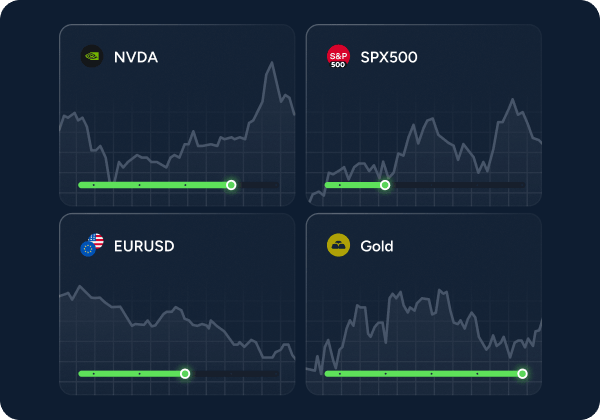
Browse by asset class
Find your market across seven asset classes.


What are trading instruments?
A trading instrument is any financial asset you can buy or sell to gain exposure to a market, such as a currency pair, a share, a commodity or an index. With ThinkMarkets, you trade these instruments as CFDs (contracts for difference), which let you take a position on price movements, up or down, without owning the underlying asset.
A single ThinkMarkets account gives you access to thousands of instruments spanning forex, stocks, indices, commodities, ETFs, synthetics and cryptocurrencies. You can trade them across ThinkTrader, MT4, MT5 and TradingView, with tight spreads, fast execution and the tools to manage risk on every position.
Frequently asked questions
A trading instrument is a financial asset you can buy or sell to gain exposure to a market, including currency pairs, shares, commodities, indices and cryptocurrencies.
You can trade thousands of CFD instruments across seven asset classes: forex, stocks, commodities, indices, ETFs, synthetics and crypto.
A contract for difference is an agreement to exchange the difference in an instrument's price between opening and closing a position, allowing you to trade on price movements without owning the underlying asset.
Yes. A single ThinkMarkets account gives you access to all available asset classes across our supported platforms.
You can trade on ThinkTrader, MT4, MT5 and TradingView.
CFDs are leveraged products, so both profits and losses can be amplified and you can lose money rapidly. You should understand how CFDs work and the risks involved before trading.